
2026 LAMPHHS Annual Meeting, June 3-4 (Buffalo, NY)
This year’s LAMPHHS meeting will be held in Buffalo, NY from June 3-4, 2026. This will be the second Buffalo gathering in our organization’s history, following a meeting held here in 1996. Registration for the in-person attendance at the conference, tours, and dinner has now closed. Registration to attend the virtual conference is available here.
2025’s Annual Meeting marked 50 years of LAMPHHS (and its predecessors, ALHHS and MeMA)! This presentation, compiled by Stephen Greenberg, includes photos from meetings and associated gatherings of years past.
Conference Information
Lodging
The meeting’s hotel is the same as AAHM/AAHN’s:
Hyatt Regency Buffalo
2 Fountain Plaza
Buffalo, NY 14202
The room rate is $159 per night plus taxes. The cut-off date for reservations at this rate is May 6, 2026.
Hotel parking is currently priced at $25.00 per night for self-parking and $29.50 per night for valet parking.
You can book your room at the group rate by clicking here or by calling (716) 856-1234. When making inquiries, mention the “AAHN rate” to ensure you get the best deal.
Please keep in mind there is also a small block of rooms reserved for LAMPHHS/AAHM for June 2nd as well. So, if you are looking to fly into Buffalo early to be here for a full day of tours on Wednesday, feel free to book that Tuesday evening too (at the discounted rate).
Travel To Buffalo
Buffalo Niagara International Airport (BUF) serves the Western New York Region. From the airport, NFTA-Metro public bus transportation ($2.00), rental cars, or ride share services can take you to the meeting hotel.
Additionally, downtown Buffalo is served by Amtrak trains. If coming by train, be sure to disembark at the Buffalo Exchange Street Station (BFX). The conference hotel is about a 20 minute walk from this station. The NFTA-Metro light rail or ride sharing can also get you to the hotel very quickly. Please note when taking the train: there is also a suburban stop in the Buffalo region, Depew Station (BUF). This station is approximately 15 miles outside of the city and much further from the hotel.
For those driving to the region, valet parking is available at the hotel for $29.50 per night (with in and out privileges). Additionally, numerous parking garages are nearby, including the Owen B. Augspurger Ramp.
Getting Around Buffalo
Just outside of the Hyatt Regency is the Fountain Plaza station of the NFTA-Metro light rail system. To the west, the light rail will take you to Lake Erie and Canalside. To the east, it terminates at the University Station, the University at Buffalo’s South Campus (this year’s conference venue). As with the busses, cost for the light rail is $2.00. Tickets for both can be purchased via phone, with the Token Transit app.
Unfortunately, the light rail does not extend to many other places one might consider visiting while in the region. For this, NFTA-Metro busses or ride sharing options would be necessary. The 20 bus travels up Elmwood Avenue, stopping near many sites of interest including the Elmwood Village area, the AKG Art Gallery, and the Buffalo History Museum.
Conference Venue
This year’s meeting will be hosted at the University at Buffalo’s Harriman Ballroom (105 Harriman Hall), on the South Campus (3435 Main Street, Buffalo, NY, 14214). This is the campus of UB’s health sciences schools (excluding the medical school, which is closer to downtown) and is home to Abbott Library and the sponsor of this year’s free meeting registration, the Robert L. Brown History of Medicine Collection.
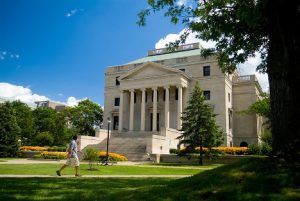
This hybrid meeting will run from 8:45AM – 4:30PM (Eastern) on June 4th, with an optional reception at nearby Abbott Library and the Robert L. Brown History of Medicine Collection from 4:30PM-6:00PM.
A draft version of the meeting’s program is available here and registration for virtual attendance to the conference is available here. (In-person attendance registration has closed.)
Bus transportation via UB Transportation will be available to transfer attendees from the conference hotel (Buffalo Hyatt Regency) to the meeting in Harriman Hall. The first bus will arrive at the Hyatt on June 4th at 7:45AM and leave for UB at 8:00AM. Busses will leave every 15 minutes, with the last bus leaving at 8:45AM.
Similarly, at the end of the day, UB busses will be available to transfer attendees back to the conference hotel. The first bus will arrive at 4:45PM and will leave for the hotel at 5:00PM. A second bus will arrive at 5:00PM and leave at 5:15PM. These will then loop between the two locations until 6:00PM.
For those interested in other modes of transportation between the conference hotel and UB’s South Campus, consider the Buffalo Metro Rail (light rail). The cost of a round trip between the conference hotel stop (Fountain Plaza Station) and UB (University Station) is $4.00. Parking on campus for non-affiliates is limited to the free park & ride lot (3435 Main St) NFTA-Metro University Station.
Wednesday Night Dinner
Our pre-conference dinner will be held from 6:00-9:00PM on June 3rd at 500 Pearl, in the 1914 Room. This historic event venue (500 Pearl Street, Buffalo NY) is located just a 7-minute walk from the conference hotel and promises to be a pleasant setting for good food & camaraderie.
The venue is fully accessible via elevator and caters to a variety of dietary needs (note at registration if you keep a vegetarian, vegan, and/or gluten free diet).
Although the kitchen at 500 Pearl cannot accommodate Kosher or Halal diets, we will work with other area restaurants to provide meals that can. If you would like to join us for this occasion, please do! Simply note your preference for a Kosher or Halal meal.

June 3rd Tours:
Registration for these tours has closed.
Buffalo and Erie County Naval & Military Park: Guided Tour of Ships and Grounds
Time: 11:00-12:30 (90 minutes)
Cost: $16.00 (per person)
Maximum Registrants: 15
Address: 1 Naval Park Cove, Buffalo, NY 14202.
Shane Stephenson, Director of Museum Collections, will lead this guided tour of Buffalo’s Naval Park, the largest inland Naval Park in the United States. Located on Buffalo’s Waterfront, this unique destination features four decommissioned Naval vessels that served in a variety of military conflicts in our nation’s history.
Vessels include the USS Little Rock, the last surviving vessel from the Cleveland-class of light cruisers in the world; the USS The Sullivans, the first ship in the U.S. Navy to be named for more than one person, one of only four remaining examples from the Fletcher-class of destroyers in the world; the USS Croaker, a Gato-class submarine on the National Register of Historic Places; and the PTF-17, one of only 20 fast patrol boats from the Nasty-class to be built, used as a high-speed reconnaissance and patrol craft in Vietnam.
As part of this tour, participants will get first hand knowledge about the challenges of having the museum’s collections stored on 80+ year old naval vessels.
Getting There: We will meet at 10:30AM in the lobby of the Hyatt Regency and walk to the Fountain Plaza light-rail stop at 10:35AM. The light-rail is free above ground, with the Naval Park located very close, about a 5-minute ride away at the Erie Canal Harbor stop.
Explore Buffalo Walking Tour: Downtown Icons & Hidden Treasures
Time: 1:00-2:30PM (90 minutes)
Cost: $20.00
Maximum Registrants: 20
Step into the grandeur of turn-of-the-century Buffalo on this downtown walking tour, where richly detailed facades and spectacular interiors reveal Buffalo’s rise as one of America’s great commercial centers. At the dawn of the twentieth century—when Buffalo ranked among the nation’s largest cities and welcomed visitors from around the world—prominent local firms such as Green & Wicks and Esenwein & Johnson shaped a downtown defined by elegance, ambition, and artistic craftsmanship.
Along the way, you’ll experience dramatic architecture up close with visits inside historic spaces such as the Goldome Bank and Electric Tower, while the intricate details of lesser-known downtown gems will reward curious explorers. You’ll see how thoughtful restoration has brought new life to historic buildings like the Curtiss Hotel. Together, the buildings on this tour create a vivid story of the enduring beauty of downtown Buffalo’s historic buildings.
This tour is approximately ninety minutes in length and 1.2 miles of walking. Register here.
For those interested in also attending the tour of the Buffalo and Erie County Public Library’s Rare Book Room at 2:30, fear not! This walking tour takes place in the same vicinity as the Public Library and we will be sure to direct those interested in attending the Library’s Rare Book Room tour to that venue at the end of this tour.
Getting There: This tour will commence from the lobby of the conference hotel, the Buffalo Hyatt Regency, at 1PM.
Buffalo and Erie County Public Library, Central Branch: Rare Book Room Tour
Time: 2:30-4:00 (90 minutes)
Cost: $0.00 (free)
Maximum Registrants: 25
Address: 1 Lafayette Square, Buffalo, NY 14203.
Lead by Heather Gring, Rare Book Curator, this tour will highlight the titles and collections held by the Buffalo Central Library’s Rare Book Room. Included among its holdings are items of local, national and international impact including Mark Twain’s original manuscript of Adventures of Huckleberry Finn, Shakespeare’s First Folio, the complete Audubon Birds of America elephant folio, the “Milestones of Science” Collection of 197 first editions of the world’s most significant scientific discoveries, an anti-slavery collection, as well as many other manuscripts and archives. Register here.
Getting There: Located within walking distance (2 minutes) of the Buffalo Hyatt Regency. Those who would like to walk with the group can meet at 2:20 in the lobby of the Hyatt before we walk over at 2:25PM.
For those also attending the Explore Buffalo walking tour, a member of the LAC will be present on the walking tour to help with wayfinding to the public library at the conclusion of that tour.
Optional Tour (on your own): Lily Dale Assembly: Tour of Grounds, Library, and Museum
Address: 5 Melrose Park, PO Box 248, Lily Dale, NY 14752
Unfortunately, we are unable to provide group transportation to Lily Dale. For those interested in visiting the grounds on June 3rd, you may explore car rental options at the Hertz, Pearl Street location. This rental location is very close (walkable) to the conference hotel.
Lily Dale is a historic late 19th century spiritualist community located about an hour from downtown Buffalo, on the shores of Cassadaga Lakes in Chautauqua County, NY. It is a renowned home for mediums and spiritualist healers, and boasts a historic spiritualist library, museum, shops, and numerous gardens and walking trails. Although the summer season (when the most activity happens) doesn’t begin until June 20, 2026, the Lily Dale Assembly office manager has noted they may be able to ensure access to the library, museum, etc. during a visit on June 3rd! Additionally, as many mediums reside in the village throughout the year, registrants who are interested in scheduling a reading during our time in Lily Dale are welcome to explore available mediums here: https://www.lilydaleassembly.org/find-a-medium
Getting There: If interested in possibly visiting, send an email to Keith Mages (kcmages@buffalo.edu) for more information.
Buffalo, Here We Come!
The 2026 LAMPHHS meeting will be held in Buffalo, NY on June 3 and 4, 2026. This marks the second time LAMPHHS (and AAHM) will be shuffling off to Buffalo, the first being in 1996. We on the Local Arrangements Committee hope you find this guide helpful as you begin to think about the forthcoming warmer months. We’re looking forward to welcoming you to the “Queen City” in early June!
Buffalo History in Brief
Situated on the shores of Lake Erie, Buffalo is the second largest city in New York, with a population of around 280,000 people. The greater metropolitan region of the city includes some 1.1 million citizens. Officially founded in 1832, the city was named after the region’s Buffalo Creek, however the origins of the creek’s name are unknown. Originally belonging to the Haudenosaunee (Iroquois) Confederacy, specifically the Seneca Nation, some believe the name comes from a mistranslation of the Seneca term for the basswood tree, others believe it was coined upon hearing the French term “beau fleuve”, meaning “beautiful river” once applied to the region. Whatever its origins, today the name Buffalo most often elicits thoughts of the Buffalo Bills, Buffalo Wings, and of course, snow.
Buffalo’s history revolves around its strategic location at the terminus of Lake Erie. During the 18th, 19th, and early 20th centuries, this location was an important nexus of international commerce and industrial production. What began as Native American lands and a French trading post would evolve into the “gateway to the west” with the completion of the Erie Canal in 1825, linking the Great Lakes to the Atlantic. Buffalo became a major 19th-century city due to its shipping, grain, and steel operations. Despite facing economic hardships in the mid- to late-20th century, today, Buffalo is a vibrant mid-size city known for its friendly people, architectural heritage, and thriving arts scene.
Health Care History in Buffalo
For a city of its size, Buffalo has a surprisingly robust connection to important moments in the history of health care. We’ll start with Buffalo Medical College (the forerunner to today’s University at Buffalo), established in 1846 by several faculty-physicians including Drs. Austin Flint and Frank Hastings Hamilton.
Austin Flint, a Harvard Medical School graduate, was a well-known diagnostician, for whom “Flint’s Murmur” is named. He was the founder of the Buffalo Medical Journal. Frank Hastings Hamilton, graduate of University of Pennsylvania’s Medical School, was an eminent surgeon who was consulted after the shooting of President Garfield in 1881. Flint and Hastings Hamilton would later be among the founders of the Bellevue Hospital Medical College.
Early graduates of the University included Dr. Cornelius N. Dorsette (1882), a formerly enslaved individual from North Carolina. Dorsette graduated from Hampton Institute before heading to Buffalo. He would go on to become Booker T. Washington’s personal physician, a staunch supporter of the Black community, and a trustee of Tuskegee Institute.
UB Faculty also contributed much to national medical advances. Ophthalmologist Dr. Lucian Howe championed New York State legislation calling for the compulsory administration of silver nitrate to newborn infants to proactively treat ophthalmia neonatorum, a leading cause of congenital blindness. After being enacted in NY in 1890, similar legislation would go on to be passed throughout the country.
The 1901 Pan-American Exposition put Buffalo in the national spotlight. The Exposition grounds were alit with electrified lights, while the X-Ray machine, infant incubators, and electric ambulance spoke of healthcare’s future. Unfortunately, the Exposition may be most well known as the site where President William McKinley was shot by Leon Czolgosz. UB faculty Drs. Mathew D. Mann and Roswell Park, among others, attended to the President over the next few days. Despite some early hope, the President would succumb to his injuries on September 14, 1901. His autopsy would be carried out by another UB faculty member, Dr. Hermen Matzinger.
During the 1950’s, Dr. Robert Guthrie developed reliable testing for phenylketonuria (PKU) and breakthroughs in implantable pacemaker technology were made by UB engineering professor Wilson Greatbatch. In the 1970’s, the Prostate Specific Antigen was also discovered here, owing to the research of Drs. Richard Ablin and T. Ming Chu.
Although not a UB story, another important advancement in health care arose from the work of Buffalo native Elisabeth Coe Marshall, who in 1885 founded a model of home care nursing which would be reproduced across the country, known today as the Visiting Nursing Association (VNA).
Visiting Buffalo
Aside from perhaps the Buffalo Bills and snow, the first thing many people think about when Buffalo comes to mind is the food. Near the conference hotel are several places to check out, some walkable, others a short ride away. Of course, aside from food, the region offers plenty of things to see and do. Take a read below to learn more about your options!
Restaurants
If you are craving chicken wings, you might wish to visit the Anchor Bar, where Buffalo wings originated in 1964. Another nearby venue, also known for quality wings is Gabriel’s Gate, located in the Allentown district. If you want to enjoy some beef on weck, take a quick ride to Larkinville and enjoy Eckl’s @ Larkin. For those craving a hearty Italian-American meal, head to historic Chef’s for their signature spaghetti parmesan. More elevated dining experiences can be found at Bacchas Wine Bar, very close to the Hyatt Regency, which offers a very nice selection of fine wines and similarly elegant food. Similarly, Inizio provides excellent service and delicious cocktails and house-made pasta in its Elmwood Village location. Also in the Elmwood Village is Mira, a newly opened Mediterranean restaurant which many seem to enjoy. Finally, very close to the hotel is the International House, a food hall featuring a variety of restaurants including those serving Ethiopian, Filipino, Mexican, and Burmese cuisines.
Of course, there are many other excellent dining options in the area, these are just a few to get you started!
Downtown Districts
The conference hotel, the Buffalo Hyatt Regency, is conveniently located in the heart of downtown Buffalo. Situated within the city’s Theater District, here you can take in a production in one of the city’s many theater venues including the historic Shea’s Buffalo, Shea’s 710 , Irish Classical Theater, Alleyway Theater, among many others.
As you make your way closer to the lake and into Buffalo’s Business District, check out the Buffalo and Erie County Public Library’s main branch, the Central Library. Also be sure to enjoy the stunning architecture of some of Buffalo’s historic buildings, such as the Guaranty Building and Buffalo City Hall. If stopping by City Hall, be sure to visit the 28th floor’s observation deck! Also in this region is Sahlen Field, home of the Buffalo Bisons a Triple-A affiliate team of the Toronto Blue Jays.
Nearby is Canalside. Built around the historic terminus of the Erie Canal, this is Buffalo’s waterfront. Here you can find the Key Bank Center, a large event venue and home of the National Hockey League’s Buffalo Sabers. Also in this region is the Buffalo Heritage Carousel, Buffalo and Erie County Naval & Military Park, and the Explore & More Children’s Musuem.
Those interested in the Underground Railroad and African American history may wish to visit the Historic Michigan Street Baptist Church in the Michigan Street Corridor, just a 5 minute drive from Canalside. While there, check out the Nash House Museum and the Historic Colored Musicians Club & Jazz Musuem.
Elmwood Village
Still within the City of Buffalo, but outside of downtown, is the Elmwood Village. Here you can stroll and enjoy a wide variety of independent shops, restaurants, and bars. Favorites include Thin Ice, Second Chic, Talking Leaves Books, and Watson’s Chocolates. If you are hungry while here, consider kuni’s for fresh sushi or Saint Neri for cocktails and caviar.
Delaware Park Area
Finally, while in Buffalo, you may wish to visit the Frederick Law Olmsted-designed Delaware Park and its many nearby museums and cultural sites. The recently expanded Buffalo AKG Art Musuem (formerly known as the Albright Knox) offers a world-class modern art experience, whereas the Buffalo History Musuem provides glimpses of Buffalo’s heyday. Also in this area are the Burchfield Penny Art Center, historic Forest Lawn Cemetery (burial ground of many of Buffalo’s prominent citizens), and the Richardson Olmsted Campus, site of the foreboding, H.H. Richardson-designed, Buffalo State Asylum and current Richardson Hotel. Finally, not far from here, you can also visit the Darwin Martin House, one of Frank Lloyd Wright’s intoxicating creations.
Further Afield
Regional fun doesn’t stop at the Buffalo city border, nearby towns just a short drive away offer additional places to explore.
Southtowns
Sports fans might want to bid adieu to the home of the Buffalo Bills for the past 53 years, Highmark Stadium, in Orchard Park, about 14 miles south of Buffalo, and wave hello to the New Highmark Stadium across the street. Next to Orchard Park is picturesque East Aurora. This village is a favorite backdrop of romantic holiday movies (think Hallmark) and features a vibrant Main Street with Vidler’s 5&10, the birthplace of the American Arts & Crafts Movement at Elbert Hubbard’s Roycroft Campus, and the home of Millard Fillmore, the 13th President of the United States.
Niagara Falls, USA and Canada
World famous Niagara Falls (New York) is located just 20 miles north of Buffalo (NFTA-Metro busses and Amtrak trains make this trip daily). Experience the raw power of nature at Niagara Falls State Park, walk among the cliff-side on the Cave of the Winds tour, or ride a boat and brave the foot of the falls abord the Maid of the Mist. Take some time to visit the Niagara Falls Underground Railroad Heritage Center and, just north of the city, Old Fort Niagara, first constructed by the French in the late 17th century!
You might consider bringing your passport to head over to the Canadian (Ontario) side of the Falls, including its lovely gardens and touristy Clifton Hill. Just north of Niagara Falls, Canada, is beautiful Niagara-on-the-Lake (NotL). A wonderful town with a distinct colonial charm, NotL features a variety of shops, an historic apothecary, and hosts the Shaw Festival which brings a variety of plays and musicals to the region throughout the year. NotL is also surrounded by a surprising number of vineyards.
Chautauqua County, NY
Located just over an hour south of Buffalo is Chautauqua County, a largely rural region of Western New York that, never-the-less, contains some surprising sites of interest. If you have the time to make the trip, consider spending some time at one of the region’s many wineries. In the small city of Jamestown, visit the National Comedy Center, the Lucille Ball Desi Arnaz Museum, and the Roger Tory Peterson Institute (Peterson was a noted naturalist, artist, and field guide creator).
Also in this region are two incredibly unique communities. Lily Dale, a spiritualist enclave founded in 1879, offers believers and skeptics alike a chance to connect with a vibrant community of mediums. Tour the assembly grounds, visit the small museum, library, and various gift shops or even attend a live mediumship reading at Inspiration Stump (these live-readings may only be available during the summer season.)
No less charming, but founded in 1874 on very different principles, is the Chautauqua Institution located just outside of Mayville, NY on the shores of Chautauqua Lake. Beginning as a summer camp for Protestant Sunday school teachers, today the Institute (as it is known) boasts an impressive assemblage of Victorian architecture, beautiful gardens, and a nine-week summer season that offers literary and scientific lectures, an assortment of educational classes, as well as symphony, dance, opera, and theater performances. Even out of season, a visit to the grounds is recommended. The historic Athenaeum Hotel offers a pleasant homebase for an evening’s stay, while the Smith Memorial Library and the Chautauqua Bookstore provide plenty of reading options for those who just want to sit a bit and take in the lovely scenery.